ALL RESOURCES
FILTER BY TAG
Select a tag
- Academic performance
- Accessibility
- Accountability
- Advocacy
- Advocates
- Article
- Bill analysis
- Bill tracker
- Billionaires
- Blog post
- Civil rights
- Coalition building
- Community Schools
- Cost impact analysis
- Dark Money
- Data
- Disability
- Discrimination
- Drain funds from public education
- Education Savings Account (ESA)
- English language learners
- Fact sheet
- Fraud Waste and Abuse
- Graphic
- History
- Indigenous and Native Education
- Integration
- LGBTQ+
- Legislation
- Letter
- Litigation
- Messaging or talking points
- Model legislation
- National Voucher
- News
- Parents
- Personal narrative
- Podcast
- Policy brief
- Policymakers
- Radio
- Referendum
- Religion
- Report
- Rural communities
- Segregation
- Separation of church and state
- Slide deck
- Slides
- State Constitutional Right to Education
FILTER BY AUTHOR
Select an author
- Aaron Sanderford
- Alec MacGillis
- Allen Pratt
- Associated Press
- Bob Peterson
- Bruce Schreiner
- Catherine Caruso
- David Montgomery
- David Pepper
- Eli Hager
- Emily Walkenhorst
- Ethan Dewitt
- Geoff Mulvihill
- Hilary Wething
- Howard Fischer
- Jason Bailey
- Jessica Corbett
- Jim Collier
- Joe Dana
- Joshua Cowen
- Juan Perez Jr.
- Kiera Butler
- Laura Pappano
- Liam Amick
- Maurice Cunnningham
- Nora De La Cour
- Paige Masten
- Patrick Darrington
- Paul Hammel
- Phil Williams
- Rob Boston
- Robert Huber
- Rowan Moore Geretsy
- Sasha Pudelski

Directional Signals: A New Analysis of the Evolving Private School Choice Landscape
Three years ago, Arizona became the first state to allow all students—regardless of income or need—to use public dollars for private school tuition and other educational expenses. The move marked a sweeping shift in the scale and scope of school choice in the United States.

Distant Dome: Education Freedom Account Expansion Will Be Costly
The parents of the 11,000 students who applied for grants from the newly opened vault in the state treasury are not the ones advocates tout as the beneficiary of the Education Freedom Account program if New Hampshire resembles other state’s experiences when they transitioned to “universal vouchers.”
Federal Voucher System — Like Florida’s — Would Divert Funding to Private Schools and Home-Schoolers
The reconciliation bill passed by the U.S. House of Representatives includes a federal tax credit voucher that would provide taxpayer-funded scholarships to pay for tuition at private schools and for home-schooled students. This $5-billion tax credit would divert funding that would otherwise go into federal coffers. This part of the reconciliation bill would make vouchers available to students in every state, even in those states where voters have opposed them like Kentucky, Colorado, and Nebraska, most recently.

How Religious Schools Became a Billion-Dollar Drain on Public Education
The center had played a key role in bringing about one of the most dramatic expansions of private-school vouchers in the country, making it possible for all Ohio families—even the richest among them—to receive public money to pay for their children’s tuition. In the mid-nineteen-nineties, Ohio became the second state to offer vouchers, but in those days they were available only in Cleveland and were billed as a way for disadvantaged children to escape struggling schools. Now the benefits extend to more than a hundred and fifty thousand students across the state, costing taxpayers nearly a billion dollars, the vast majority of which goes to the Catholic and evangelical institutions that dominate the private-school landscape there.
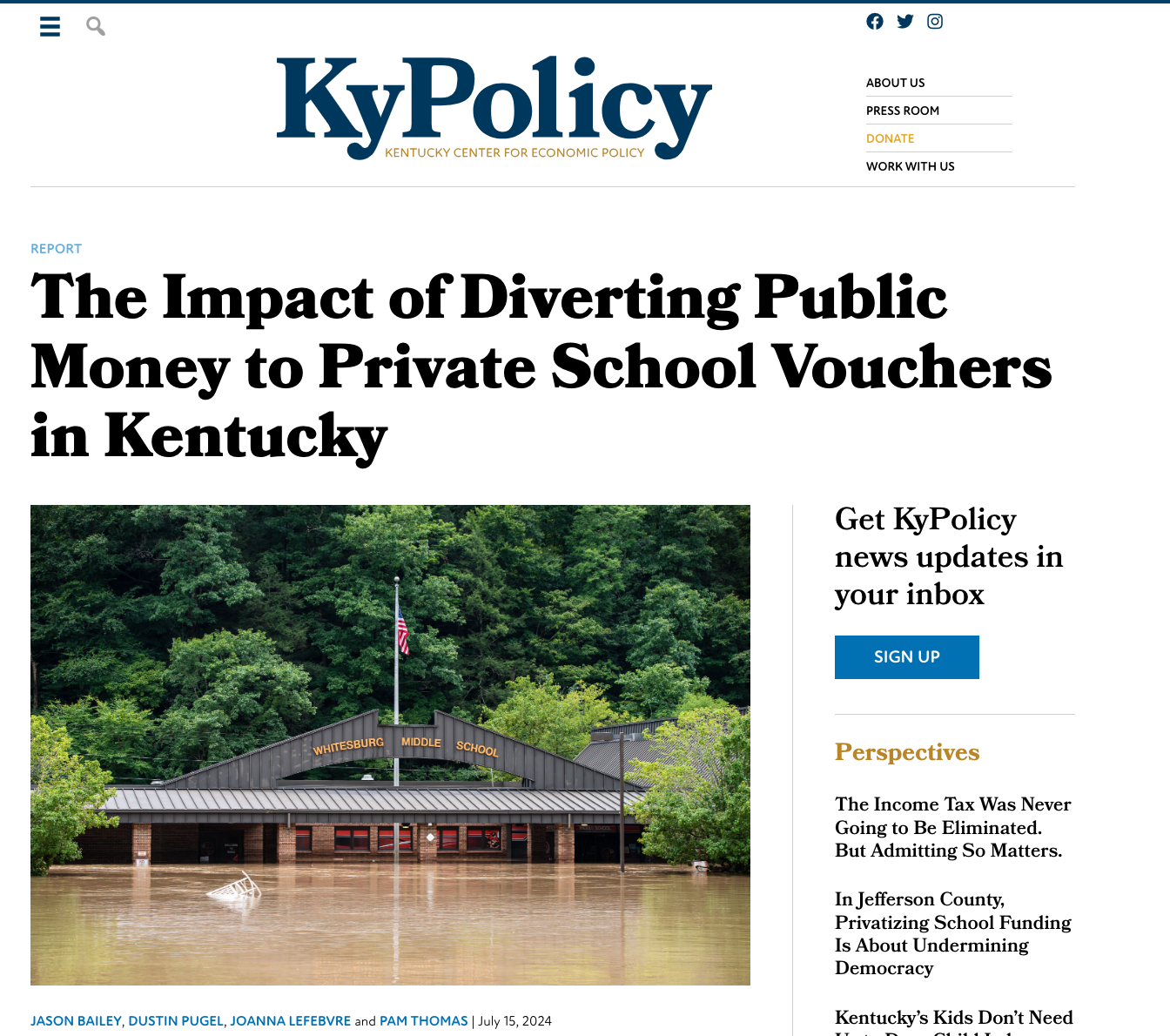
The Impact of Diverting Public Money to Private School Vouchers in Kentucky
The Kentucky General Assembly enacted a private school voucher program in 2021 and legislation was filed to expand the program before the state Supreme Court struck it down for violating Kentucky’s constitution. That decision led directly to the legislature putting Amendment 2 on the ballot. Similar states that lack Kentucky’s constitutional protections for public education have recently increased spending on vouchers and school privatization at a rapidly growing cost to their budgets. Given that history and context, it is plausible to assume the legislature will pursue a similar path if voters approve the amendment.

Be wary of what you read in the school voucher debate
The information surrounding universal voucher programs is rife with advocacy masquerading as research.
School Privatization Policy Brief
The Southern Education Foundation developed this policy brief SEF in opposition to all school voucher programs, education savings accounts, tax credit scholarship programs, and any other efforts to fund private schools with public dollars. In the seventeen states SEF serves, twelve states operate school privatization programs that provide either school vouchers, tax-credit scholarships, or education savings accounts, resulting in 276,000 participating students and amounting to $1.6 billion in state funding or tax benefits to fund private schools or pay for private education services.