ALL RESOURCES
FILTER BY TAG
Select a tag
- Academic performance
- Accessibility
- Accountability
- Advocacy
- Advocates
- Article
- Bill analysis
- Bill tracker
- Billionaires
- Blog post
- Civil rights
- Coalition building
- Community Schools
- Cost impact analysis
- Dark Money
- Data
- Disability
- Discrimination
- Drain funds from public education
- Education Savings Account (ESA)
- English language learners
- Fact sheet
- Fraud Waste and Abuse
- Graphic
- History
- Indigenous and Native Education
- Integration
- LGBTQ+
- Legislation
- Letter
- Litigation
- Messaging or talking points
- Model legislation
- National Voucher
- News
- Parents
- Personal narrative
- Podcast
- Policy brief
- Policymakers
- Radio
- Referendum
- Religion
- Report
- Rural communities
- Segregation
- Separation of church and state
- Slide deck
- Slides
- State Constitutional Right to Education
FILTER BY AUTHOR
Select an author
- Aaron Sanderford
- Alec MacGillis
- Allen Pratt
- Associated Press
- Bob Peterson
- Bruce Schreiner
- Catherine Caruso
- David Montgomery
- David Pepper
- Eli Hager
- Emily Walkenhorst
- Ethan Dewitt
- Geoff Mulvihill
- Hilary Wething
- Howard Fischer
- Jason Bailey
- Jessica Corbett
- Jim Collier
- Joe Dana
- Joshua Cowen
- Juan Perez Jr.
- Kiera Butler
- Laura Pappano
- Liam Amick
- Maurice Cunnningham
- Nora De La Cour
- Paige Masten
- Patrick Darrington
- Paul Hammel
- Phil Williams
- Rob Boston
- Robert Huber
- Rowan Moore Geretsy
- Sasha Pudelski

Federal Voucher Program – FAQs
The expansion of private school vouchers through the inclusion of a federal voucher scheme in the budget reconciliation bill passed in July is part of a broader assault on public education designed to privatize one of the most important common goods underpinning American democracy. Opting in to the federal program (the state’s choice), even to use voucher money for public education students, broadly endangers public education and opens the door to further voucher expansion, whether vouchers are already available in a given state or not.
Big Ugly Bill Implications for Our Public Schools
These slides summarize the impact of the national voucher program and cuts to SNAP/Medicaid in the Trump administration's budget reconciliation bill.

States Must Reject Harmful Voucher Program
The federal voucher program contained in the budget reconciliation bill passed in early July will divert federal tax dollars from the U.S. Treasury and from services, including public education, that Americans rely on, to give to private and religious schools that pick and choose whom they educate and openly discriminate against some students and families.

Trump’s ‘Big Beautiful Bill’ Will Devastate Public Schools. America’s Kids Will Pay the Price
This week, Republican lawmakers are attempting to pass a budget reconciliation bill that pays for unprecedented handouts to the wealthiest Americans on the backs of cuts to programs that benefit most people. Hidden in this budget package before the House is a national private school voucher program funded through tax breaks for the wealthy that threatens to dismantle our system of public schools.

New Federal Tax Credit Boosts School Choice—but Blue States Face Big Decision
School-choice advocates won a major victory with President Trump’s tax megabill—but it comes with a catch.
The federal government will now subsidize private-school tuition, via unusually generous tax credits for donations to nonprofits. However, governors must opt into the program. Democratic-led states may reject it, derailing school-choice advocates’ goal for a nationwide effort.
Labor Voices: Hometown schools at risk from federal voucher program
Whether it’s the buzz of a Friday night football game, the excitement of a school play or the familiar faces in the school pick-up line, our hometown public schools are at the heart of who we are as Michiganians.
But a new national school voucher program enacted as part of the recently passed federal spending plan could have devastating impacts on school communities in towns across Michigan.

Scamming Our Schools: Robbing Our Students’ Futures to Line Their Pockets
Senator Mazie K. Hirono (D-HI) led a spotlight forum focused on the harmful consequences the Republicans’ “Big Beautiful Bill” will have on students, parents, teachers, and schools across the country. Specifically, the forum highlights the school voucher-related provisions from the bill, which would divert billions of dollars in taxpayer funding to create the first ever national school voucher program.
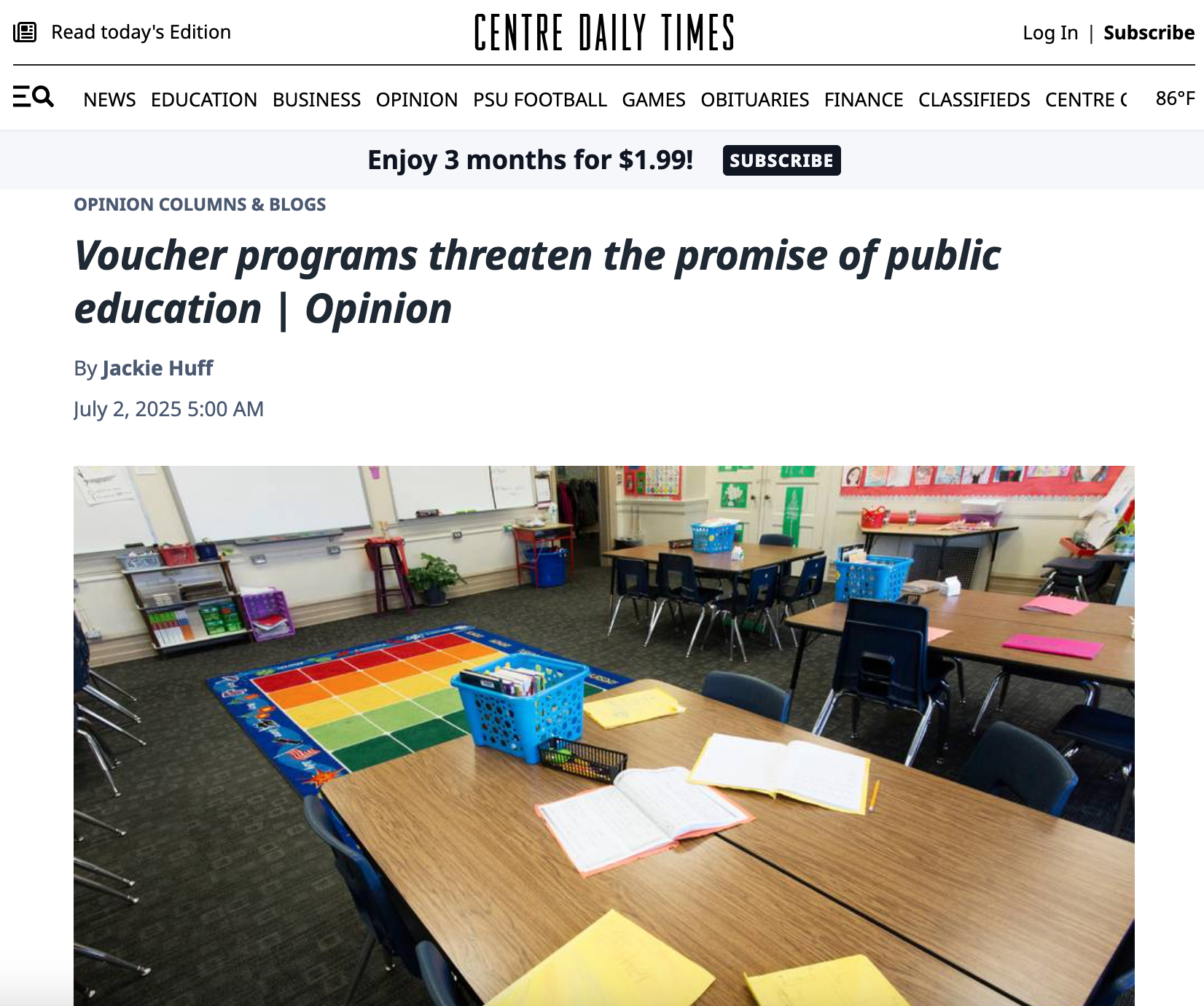
Voucher programs threaten the promise of public education
Today, we face a troubling trend. The push for voucher programs that redirect public funds to private schools threatens to abandon the fundamental promise of public education. While these programs sound appealing on the surface, they risk dismantling the very foundation that makes American education a beacon of opportunity for all.
Megabill Takes Cap Off Unprecedented Private School Voucher Tax Credit, Potentially Raising Cost by Tens of Billions Relative to Earlier Version
The tax and spending legislation signed on Friday by President Trump will create an unprecedented, dollar-for-dollar federal tax credit designed to support private and religious K-12 schools. The credit will fully reimburse donors for the first $1,700 they give to groups that hand out tuition vouchers to attend private schools. There is no other cause—not children’s hospitals, veterans’ groups, or disaster relief—that taxpayers can contribute to and see the entire cost of their contribution bankrolled by the federal government.

Public Funds Belong in Public Schools
High-quality public schools are a common good that serve as the bedrock of a high-functioning, multiracial democracy. Yet across Ohio, lawmakers are prioritizing the interests of wealthy donors over the needs of the 10.6 million students who attend public school. Public Funds Belong in Public Schools is a toolkit created for everyday Ohioans who want to stand up for public education and push back against the expansion of private school vouchers.

The Private Eye
Researcher Josh Cowen has developed a newsletter alongside Public Funds Public Schools on school vouchers and right-wing politics.

The People Have Spoken: Private School Vouchers Have A Long Track Record Of Failure At The Ballot Box
Voters in Arizona in November rejected a plan to expand private-school vouchers in the state by 65 to 35 percent. The lopsided results might have been a surprise to school-voucher boosters, but they shouldn’t have been. Vouchers and other forms of private-school aid plans have been getting trounced at the ballot box since 1967.
The Fiscal Impacts of Expanded Voucher Programs and Charter-School Growth on Public Schools: Recommendations for Sustaining Adequate and Equitable School Finance Systems
The U.S. Department of Education has projected enrollment declines over the next decade, leading to budget cuts for school districts, which will be particularly impactful in urban and rural areas serving vulnerable students. As federal COVID-19 funds expire, districts will face challenges in cutting costs, potentially leading to layoffs or school closures. Meanwhile, many states have expanded voucher programs and charter schools, diverting funds from public schools despite limited enrollment growth. Research shows these shifts harm traditional public school financing. To address this, policymakers must ensure equitable funding for public schools and hold charter and private schools to the same standards as public ones.

Failing charter school closed by Az regulators reopened as a taxpayer-funded private religious school
Arizona does no vetting of new voucher schools. Not even if the school or the online school “provider” has already failed, or was founded yesterday, or is operating out of a strip mall or a living room or a garage, or offers just a half hour of instruction per morning. (If you’re an individual tutor in Arizona, all you need in order to register to start accepting voucher cash is a high school diploma.)

Voucher Boondoggle: House Advances Plan to Give the Wealthy $1.20 for Every $1 They Steer to Private K-12 Schools
While there was never any question as to whether the committee’s majority supported private school vouchers, this is the first time they have gone on the record specifically endorsing the kind of profitable tax shelter embedded in many voucher programs. As we learned yesterday, most of the House Ways & Means Committee is content to facilitate new forms of wasteful tax avoidance if doing so aids the cause of funneling more public resources into private K-12 schools.
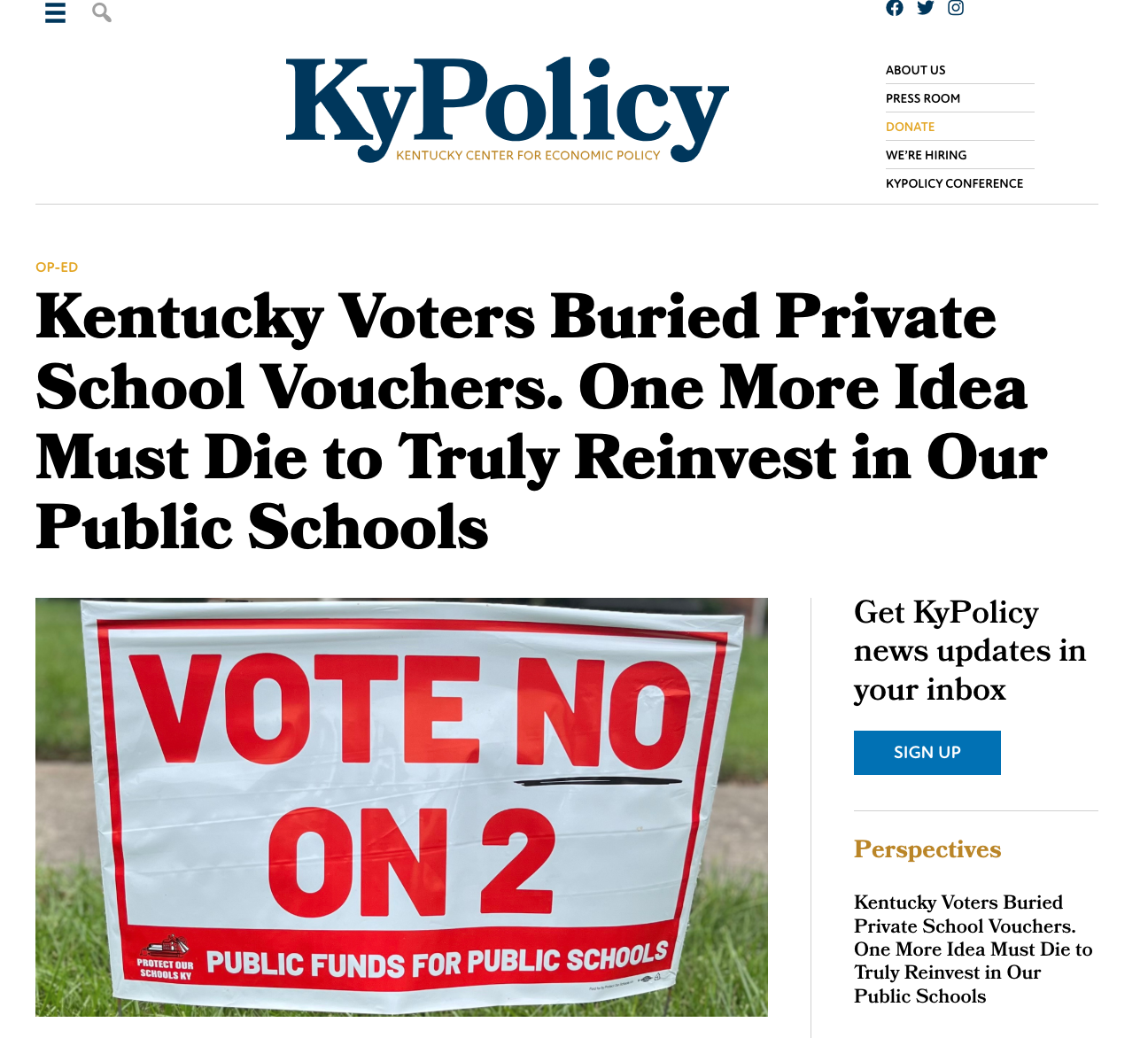
Kentucky Voters Buried Private School Vouchers. One More Idea Must Die to Truly Reinvest in Our Public Schools
Despite the best efforts of anti-public school activists and the deep pockets of out-of-state billionaires, Kentucky voters resoundingly defeated the proposed constitutional amendment allowing public dollars to be diverted to private schools. The amendment was rejected in all 120 Kentucky counties and at the hands of a unique bipartisan coalition of rural, urban and suburban voters.

States Should Bolster, Not Undermine, Education Gains Made with ESSER Funds
Over half of states divert public dollars away from public schools to private schools through school vouchers. In 2024, 14 states enacted new, or expanded existing, school voucher programs, and Colorado and Kentucky are considering legalizing school vouchers through ballot measures. For example, Florida will spend almost $4 billion on its school voucher program this year, an amount that could easily replace Florida’s total annual ESSER loss if invested in public, rather than private, schools.

What Is In The Federal School Voucher Bill
The Educational Choice for Children Act of 2024, introduced by Representative Adrian Smith (R-NE-3), would create school vouchers on the federal level, and as with all voucher programs, the devil is in the details. What do we find when we take a look under the hood?

Protect Public Schools: An Advocacy Toolkit to Fight School Voucher Programs
School voucher programs and their many iterations (education savings accounts, tax credits, etc.) drain funds from public schools while disproportionately harming Black and Brown students from low-income backgrounds and students with disabilities. This toolkit provides the resources and information communities need to launch effective advocacy campaigns against school voucher programs in their state.

Anti-Voucher Victories in 2024: A Conversation with Education Advocates from MS, NJ, ID, TX and TN
Although private school voucher programs continue to spread across the country, many states have remained voucher-free or held off significant expansions. In this webinar experienced advocates discussed the work of their organizations and numerous allies to oppose voucher legislation. They offered insight, strategies, and tips for others working against school privatization in their states, with plenty of time for Q&A.