ALL RESOURCES
FILTER BY TAG
Select a tag
- Academic performance
- Accessibility
- Accountability
- Advocacy
- Advocates
- Article
- Bill analysis
- Bill tracker
- Billionaires
- Blog post
- Civil rights
- Coalition building
- Community Schools
- Cost impact analysis
- Dark Money
- Data
- Disability
- Discrimination
- Drain funds from public education
- Education Savings Account (ESA)
- English language learners
- Fact sheet
- Fraud Waste and Abuse
- Graphic
- History
- Indigenous and Native Education
- Integration
- LGBTQ+
- Legislation
- Letter
- Litigation
- Messaging or talking points
- Model legislation
- National Voucher
- News
- Parents
- Personal narrative
- Podcast
- Policy brief
- Policymakers
- Radio
- Referendum
- Religion
- Report
- Rural communities
- Segregation
- Separation of church and state
- Slide deck
- Slides
- State Constitutional Right to Education
FILTER BY AUTHOR
Select an author
- Aaron Sanderford
- Alec MacGillis
- Allen Pratt
- Associated Press
- Bob Peterson
- Bruce Schreiner
- Catherine Caruso
- David Montgomery
- David Pepper
- Eli Hager
- Emily Walkenhorst
- Ethan Dewitt
- Geoff Mulvihill
- Hilary Wething
- Howard Fischer
- Jason Bailey
- Jessica Corbett
- Jim Collier
- Joe Dana
- Joshua Cowen
- Juan Perez Jr.
- Kiera Butler
- Laura Pappano
- Liam Amick
- Maurice Cunnningham
- Nora De La Cour
- Paige Masten
- Patrick Darrington
- Paul Hammel
- Phil Williams
- Rob Boston
- Robert Huber
- Rowan Moore Geretsy
- Sasha Pudelski

Federal Voucher Program – FAQs
The expansion of private school vouchers through the inclusion of a federal voucher scheme in the budget reconciliation bill passed in July is part of a broader assault on public education designed to privatize one of the most important common goods underpinning American democracy. Opting in to the federal program (the state’s choice), even to use voucher money for public education students, broadly endangers public education and opens the door to further voucher expansion, whether vouchers are already available in a given state or not.

Scamming Our Schools: Robbing Our Students’ Futures to Line Their Pockets
Senator Mazie K. Hirono (D-HI) led a spotlight forum focused on the harmful consequences the Republicans’ “Big Beautiful Bill” will have on students, parents, teachers, and schools across the country. Specifically, the forum highlights the school voucher-related provisions from the bill, which would divert billions of dollars in taxpayer funding to create the first ever national school voucher program.

What You Need to Know About the National Private School Voucher Proposal
School vouchers allow families to use public funds to pay for their children’s private school tuition. School voucher programs enacted across the country – using tax credits, grants, and savings accounts to divert public funding to pay for private education – have consistently demonstrated that states with voucher programs tend to expand the programs over time. These expansions dramatically increase the amount of public funds diverted to private education while state investments in public education remain stagnant or decrease. Despite the numerous negative consequences of using publicly funded vouchers to pay for K-12 private education expenses,1 policy makers across the country continue to propose similar programs.
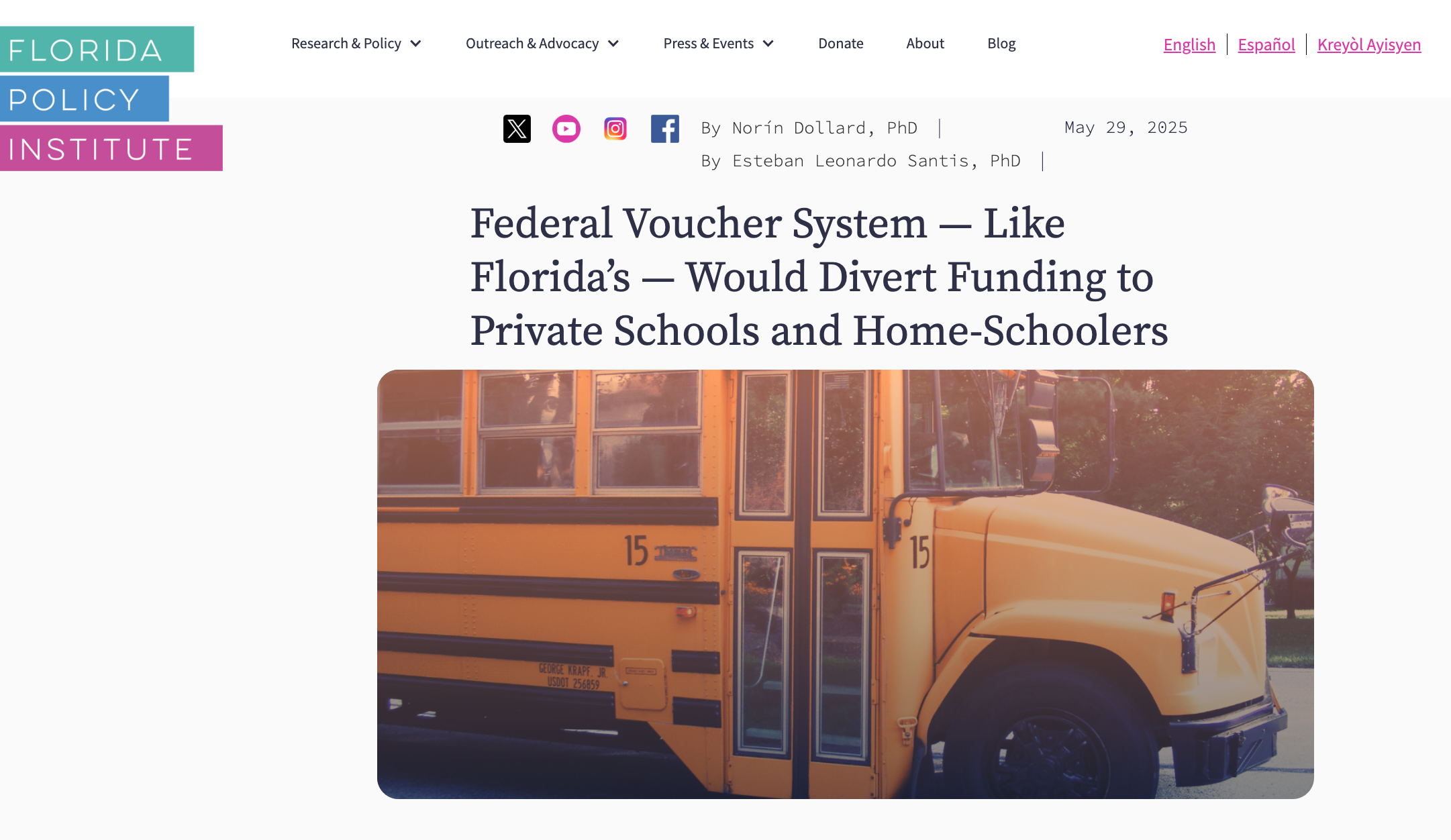
Federal Voucher System — Like Florida’s — Would Divert Funding to Private Schools and Home-Schoolers
The reconciliation bill passed by the U.S. House of Representatives includes a federal tax credit voucher that would provide taxpayer-funded scholarships to pay for tuition at private schools and for home-schooled students. This $5-billion tax credit would divert funding that would otherwise go into federal coffers. This part of the reconciliation bill would make vouchers available to students in every state, even in those states where voters have opposed them like Kentucky, Colorado, and Nebraska, most recently.

Parents and Allies Oppose National Private School Voucher Program
Policymakers join parents, students, educators and allies to discuss how the national private school voucher program in the budget reconciliation bill would shift resources from public schools to wealthy people and private schools.
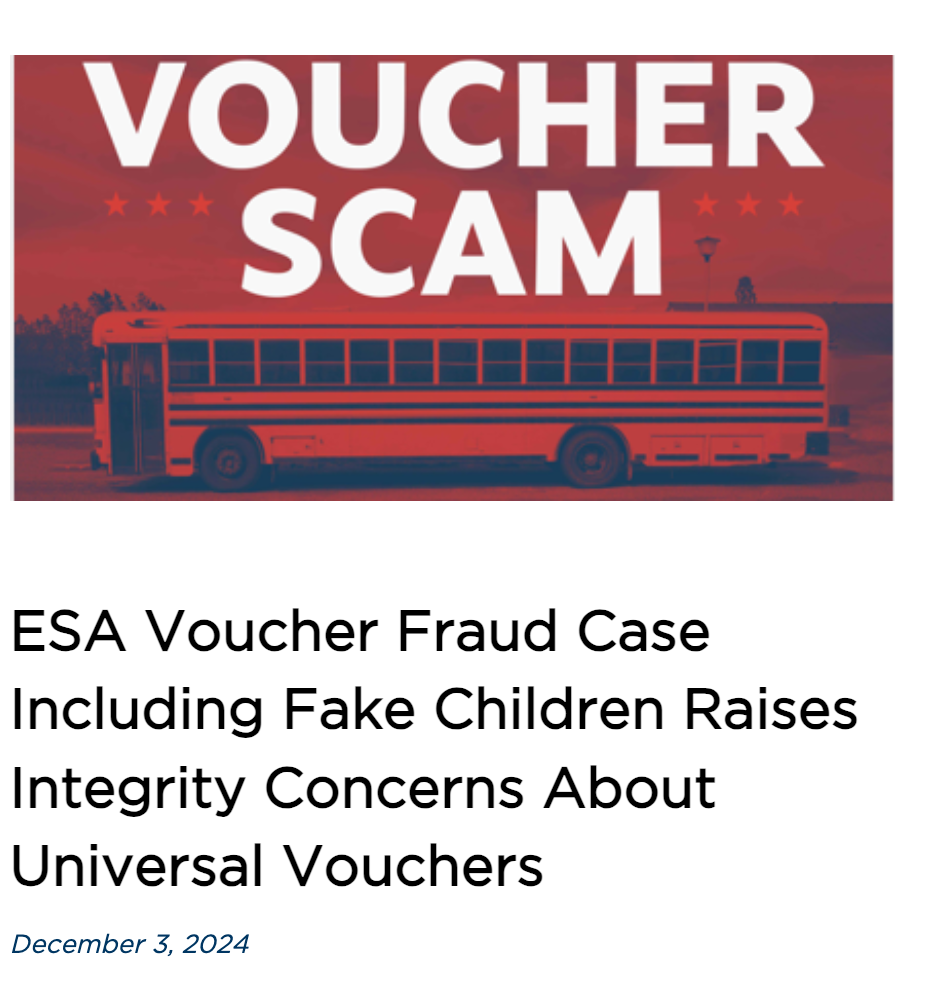
ESA Voucher Fraud Case Including Fake Children Raises Integrity Concerns About Universal Vouchers
On Monday, Dec. 2, news broke that an out-of-state couple were indicted for defrauding the Empowerment Scholarship Account (ESA) universal voucher program, by submitting applications for 50 children, 43 of whom do not exist, according to the Arizona Attorney General’s Office.

The Private Eye
Researcher Josh Cowen has developed a newsletter alongside Public Funds Public Schools on school vouchers and right-wing politics.

Failing charter school closed by Az regulators reopened as a taxpayer-funded private religious school
Arizona does no vetting of new voucher schools. Not even if the school or the online school “provider” has already failed, or was founded yesterday, or is operating out of a strip mall or a living room or a garage, or offers just a half hour of instruction per morning. (If you’re an individual tutor in Arizona, all you need in order to register to start accepting voucher cash is a high school diploma.)

Oppose $20 Billion Federal Private School Voucher Program
House Republican leadership want to include a $20 billion private school voucher program in the 2025 tax-reconciliation bill. Known as the Educational Choice for Children Act of 2024 (H.R. 9462 in the 118th Congress), it would give away $5 billion per year for each of the next four years of federal taxpayer dollars to fund private school vouchers. Instead of directing resources to the public schools that 90% of American children attend, vouchers divert critical federal dollars to students already attending private schools and to schools that can cherry pick which students they want to educate.

Keep Public Funds in Public Schools.Oppose $20 Billion National Private School Voucher Program Proposal
The Educational Choice for Children Act (H.R. 9462 in the
118th Congress) would give away $5 billion per year to
fund private school vouchers. Vouchers divert critical
funds from public schools to subsidize/pay for students,
many who already attend private schools. Private schools
cherry pick which students they want to admit, resulting
in discrimination.